BMW ended a 27-year wait for a top-level endurance victory with an early strategy call, a perfectly timed neutralisation and a final sprint separated by less than two seconds.
By Richard Ley · Research assistance: Ruben, pit.report AI race analysis · Revised 2 August 2026
Status: rewritten and fact-checked, ready for editorial approval. Hero image requires final DPPI selection and usage confirmation.
Hero image placeholder: number 20 BMW M Hybrid V8 at Spa, preferably during the final stint or with the number 15 behind. Credit: DPPI.
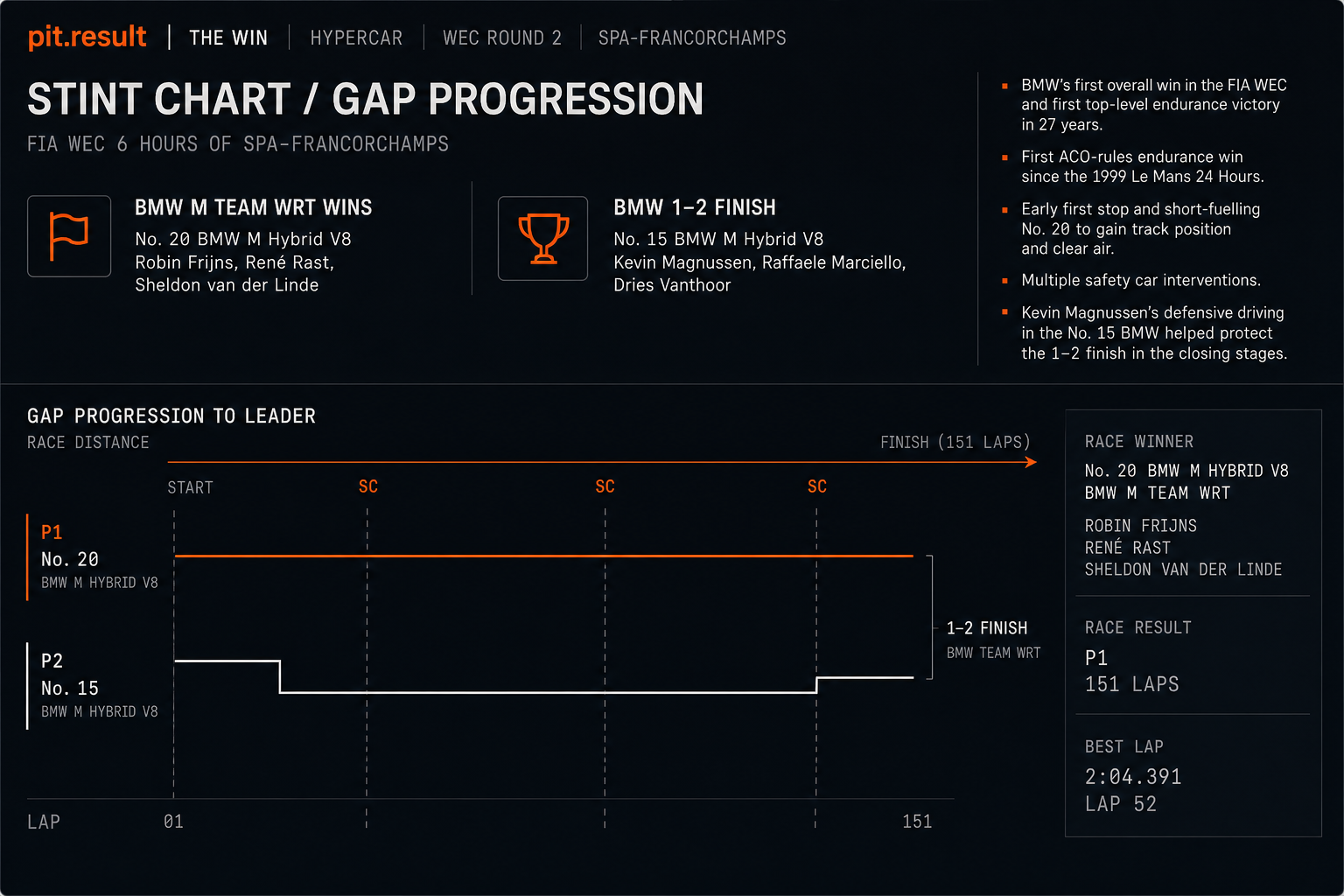
BMW’s winning move began during the first round of stops. Team WRT short-fuelled the number 20 M Hybrid V8 and returned René Rast to clear air, away from the conventional strategy of the leaders. The call placed the car out of sequence. A later neutralisation brought the field back onto comparable fuel windows while the BMW retained track position.
Rast, Sheldon van der Linde and Robin Frijns then had to complete the result through a disrupted final phase. Frijns took the number 20 to the flag, while Kevin Magnussen defended second place in the sister number 15 against Ferrari and the rest of the closing pack. The two BMWs finished 1.969 seconds apart. The number 50 Ferrari was third, only 0.653 seconds behind the second BMW.
The margins matter because this was not a comfortable procession. It was BMW’s first outright FIA WEC victory and its first win at the top level of international endurance racing since Le Mans in 1999. Team WRT also claimed its first overall WEC win, at its home circuit and in the most competitive final minutes of the race.
BMW did not simply benefit from timing. The early stop created the position, the neutralisation protected its value and the drivers defended it. Spa was a strategy win, but strategy only mattered because the car had enough pace to remain at the front when the race compressed around it.
Nederlandse editie
Eén vroege stop, één late verdediging: BMW’s eerste FIA WEC-zege
BMW beëindigde een wachttijd van 27 jaar op een overwinning in de topklasse met een vroege strategische keuze, een gunstig getimede neutralisatie en een slotsprint met minder dan twee seconden verschil.
De winnende zet van BMW begon tijdens de eerste pitstopronde. Team WRT tankte de nummer 20 M Hybrid V8 kort en stuurde René Rast terug de baan op in vrije lucht, buiten de reguliere strategie van de leiders. De keuze bracht de auto uit de normale cyclus. Een latere neutralisatie trok de brandstofvensters weer naar elkaar toe, terwijl de BMW zijn baanpositie behield.
Rast, Sheldon van der Linde en Robin Frijns moesten het resultaat daarna afmaken in een onrustige slotfase. Frijns bracht de nummer 20 naar de finish, terwijl Kevin Magnussen in de zusterauto nummer 15 de tweede plaats verdedigde tegen Ferrari en de rest van het samengepakte veld. De twee BMW’s finishten met 1,969 seconde verschil. De Ferrari nummer 50 werd derde, slechts 0,653 seconde achter de tweede BMW.
Die marges doen ertoe, omdat dit geen comfortabele optocht was. Het was BMW’s eerste overall overwinning in het FIA WEC en de eerste zege in de internationale endurance-topklasse sinds Le Mans 1999. Ook Team WRT pakte zijn eerste overall WEC-zege, op het thuiscircuit en tijdens de meest competitieve minuten van de race.
BMW profiteerde niet alleen van timing. De vroege stop creëerde de positie, de neutralisatie beschermde de waarde ervan en de rijders verdedigden het resultaat. Spa was een strategische overwinning, maar die strategie telde alleen omdat de auto snel genoeg bleef toen de race zich rondom hem samenperste.
Primary sources: Official Spa results · BMW breaks through at Spa · BMW history after Spa
pit.report · Internal copy · Publish only after final editorial approval and image clearance