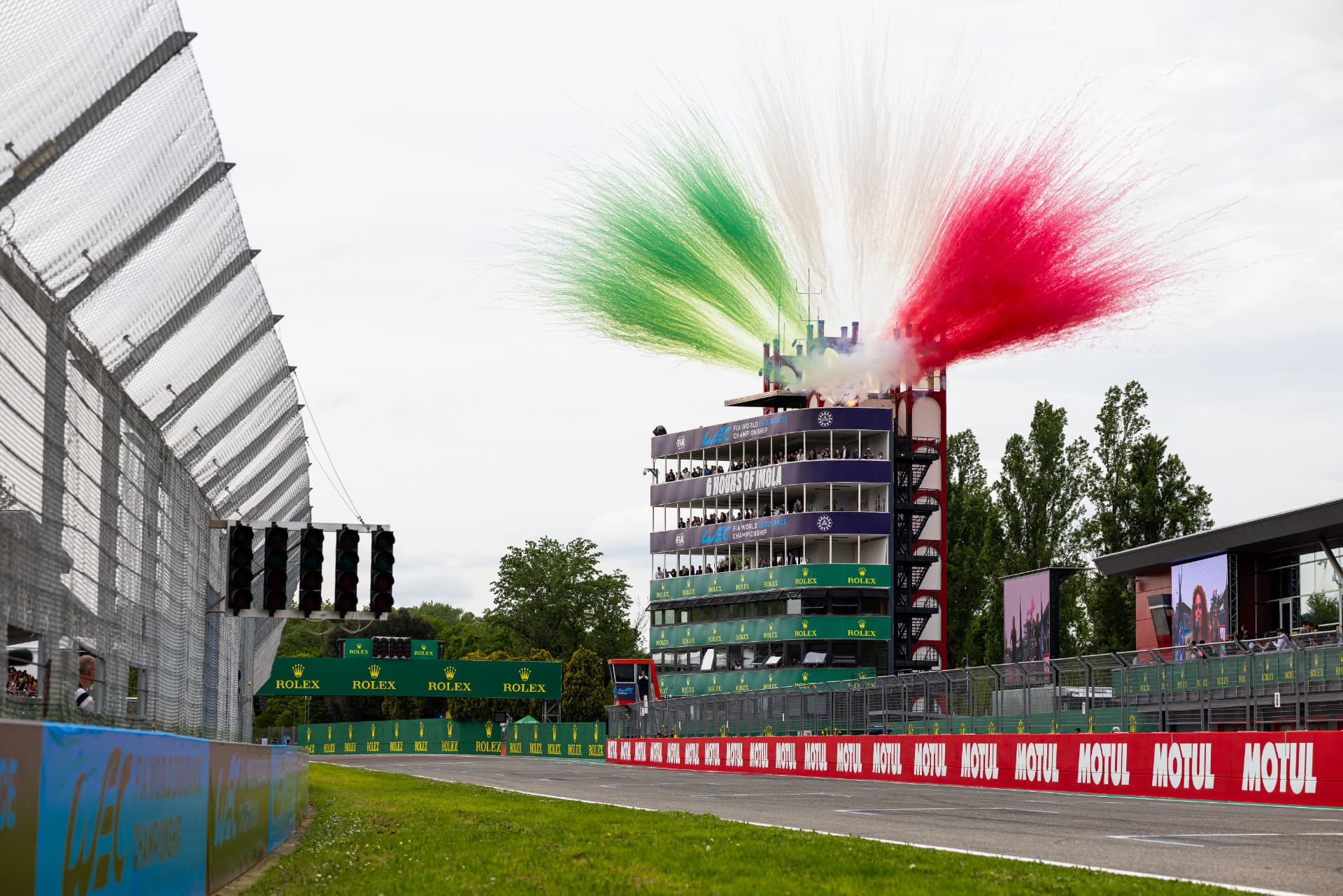
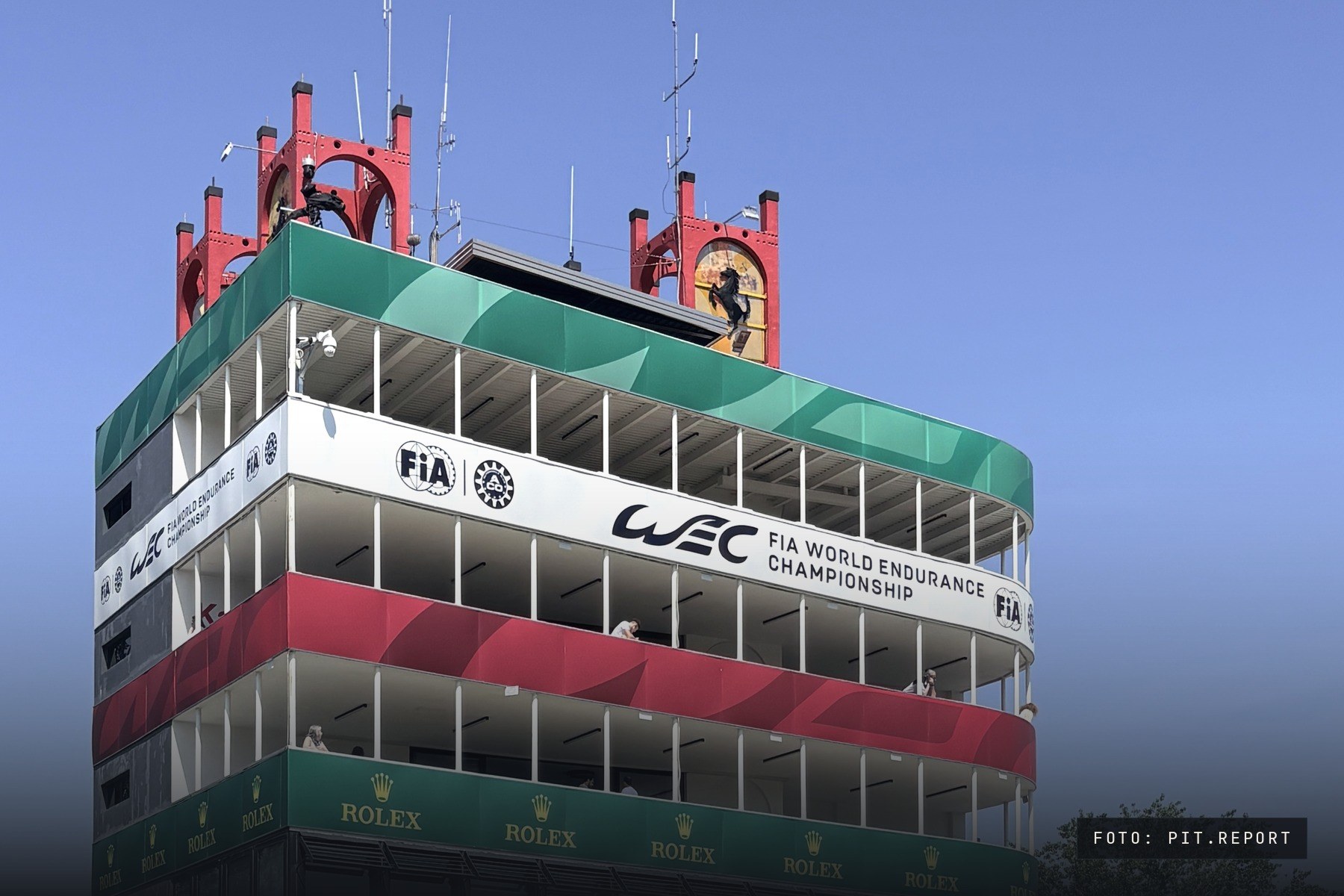
Of the 4.909 kilometres, the start-finish stretch is the only place a car can stay flat for long. The rest threads up and down alongside the Santerno: two chicanes in the first sector, a half-blind crest at Piratella, the climb to Variante Alta, the long descent through Rivazza. And all of it anti-clockwise, which beyond Interlagos and a handful of others is rare enough that drivers notice it first in their necks.
Hermann Tilke reworked the track for the Formula One return in 2020, but he worked with restraint. Narrow stayed narrow; overtaking stayed difficult. And it stayed Ferrari country. No manufacturer has won here more often, Maranello sits eighty kilometres away in the same Motor Valley, and on a race Sunday the hillsides belong to the tifosi.
What separates Imola from almost every modern circuit is simpler than any of that. It does not sit on a plain outside town; it sits inside one. The track is a narrow ribbon between the Parco delle Acque Minerali, the first hills and the housing along the river. It began in 1950 as a chain of suburban roads, and that has never quite left it: run-off is scarce. The tight run-off at Tamburello proved fatal in 1994, and in 2024 more gravel had to go in again, at Piratella and the Acque Minerali corners among others.
The town gets something back. The park in the infield is open almost the whole year and closes only for Formula One and the WEC. On open days anyone can walk or cycle the five kilometres, and mid-week the people of Imola run their laps there, on the same asphalt where the Hypercars line up in April.
The plan for a permanent circuit came just after the war, from four motorsport enthusiasts in Imola. The best known signature on the project belongs to someone else. Enzo Ferrari visited the sloping ground along the Santerno in the spring of 1948 and saw the point of it at once: the natural changes in elevation meant that here, as he put it later in his memoirs, a small Nürburgring could be built. He stood at the front when the first stone was laid in 1950, and the sports body CONI added forty million lire, which Ferrari regarded as the institution's first real gesture towards motor racing.
Checco Costa's circuit opened on 25 April 1953, with motorcycles. Cars followed in 1954, and the bill was an event in itself: Ferrari against Maserati in the Coppa d'Oro Shell. The first car to test the new asphalt, in 1952, was inevitably a Ferrari, with the world champion Alberto Ascari driving.
The family name reached the circuit through a loss. Dino Ferrari, Enzo's son, died in 1956 at twenty-four; the circuit was named after him in 1970. When Enzo himself died in 1988, his name was added. Since then it has been, in full, the Autodromo Internazionale Enzo e Dino Ferrari.
Even the name of the race betrays how badly Italy wanted to run here. In 1980 Imola took the Italian Grand Prix from Monza for a single year. That went well enough that from 1981 a San Marino Grand Prix was invented, named after the microstate eighty kilometres away, purely to get a second home race onto the calendar. The device worked through to 2006, in front of grandstands that filled like a football ground.
For a six-hour race all of that adds up to one thing: track position is gold. Passing rarely works, so qualifying weighs more heavily here than at most WEC venues and the openings move to the pit stops instead. Add elevation change that punishes tyres and gravel that has sat closer to the racing line since 2024, and the season opener shows immediately which team has its house in order. Ferrari's home advantage is the standing second storyline.
And for anyone who wants to see the place without a race weekend: the park is open. You can take Tamburello at walking pace.
The circuit in numbers
- Location
- Imola, Emilia-Romagna · 40 km from Bologna
- First stone · opening
- 1950 · 25 April 1953
- Design
- Checco Costa
- Length · direction
- 4.909 km · anti-clockwise
- Reprofiling
- Hermann Tilke (2020)
- F1 lap record
- 1:15.484, Lewis Hamilton, 2020
- Name since
- Enzo e Dino Ferrari (1988)
- WEC
- Since 2023 · 2026: season opener